We are all in it together.

Point to Ponder: This morning I sit in a place I never thought I would sit; I am the outcast for I don’t suffer the same fate as these brave people. But I know the same fate lurks among us all, and it picks and chooses its target at its own whim.

The faces of those here show bravery, hope, disappointment, and fright all at once. They talk among themselves, some nonstop, others with caution. They come in, sit, are called, and go forth with anxiety and trust. I pray for each as they disappear into the back rooms.

We are all joined in the great mystery of life; some understand, others don’t. Some ramble forth with great hope, others seem to have given up. We are all guessing. No one knows the answers and only a fool believes he has them all. One man’s quest is another’s folly.

The point of my rambling is that we are all in it together. A big mass of humanity that can accomplish so much when united, or fall flat on our faces when divided. The higher callings of the better aspects of men are often unheeded at our own expense. We should seek the refinement of that higher calling, yet it seems division and chaos are ruling the day. It’s the same as it ever was.

We can do better. How? Focus on the good, the pure, the right, honest, and just within ourselves. Be the best you can be and show compassion for others that do the same. Trust in a higher power rather than the fools that our attempting to have you join in their idiocy. Ignore those that attempt to impose division and rancor among all in order to gain power for themselves. Believe with all your heart in the power God has bestowed upon you. For the individual is the masterpiece of the Devine…no one else like you has ever existed or will exist again. Believe in yourself, for that is where the true power lies. Share that power with others and lead.

Perhaps it’s not that simple, but it’s a start. We can do better and it begins with each of us…as individuals. Start today. Please.

What if America’s flame were extinguished?

What would America look like without a Constitution or Bill of Rights? We don’t have to think very hard, because we have a recent example.

CNN produced a “Town Hall Meeting” in Sunrise Florida last week in the aftermath of the Parkland High School tragedy. It was a gathering of people still in the grip of an emotional event; their nerves were raw and their quest for immediate solutions and answers were high. It was ill-timed at best.

But it occurred nonetheless and what I saw was frightening. It was a mob scene instigated by CNN and its power to inflate hysteria. Without controls and monitoring by the host, the crowd was after blood. If it were up to crowd, those with an opposing view would have been hung and quartered as the masses cheered.

The beauty of our Constitution and Bill of Rights, unlike any other document in history, is that, in part, all are treated fairly, tyranny is held in abeyance, and mobs don’t rule. Without order and guidance, groups of people tend to lose their minds and forget logic and the rights of others. The United States of America’s Constitution and Bill of Rights prevents that from happening.

When I see the recent call for the elimination of the electoral college, or the Second Amendment, I take pause and sigh. How have we arrived at this point in America were we accept that such fundamental change is OK? For as sure as the electoral college or the second amendment are eliminated, so will be the rights of free speech, representation, and the litany of other guarantees we find exceptional among dignified and free men.

So as I watch the folly of some unfold, I question their motives. Why would some want to eliminate what is unique in history that affords men the best shot at freedom ever derived? I hope you pause and reflect, also. Then think very deeply about the consequences, for as sure as the sun rises, men resort to mob rule if given the opportunity. And that is a change I fear for myself, our children, and future generations the most.

Have we lost our minds?

What has changed in American society since our founding to cause a spike in mass school shootings?

The total number of shootings (including suicide, accidental, and deliberate of ALL types) to date (from 1764 to the 14th of February 2018) is 467 incidents. In the 1700s, we had one. In the 1800s, there were 28 and the 1900s, 228. Since the beginning of 2000, there have been 212.

In those shooting incidents, ten people were killed in the the only incident of the 1700s (by melee guns and not a ranged weapon when American Indians entered Enoch Brown’s classroom and killed the teacher and nine students). In the latest incident on 14 February, a student with mental and disciplinary issues killed 17 of his fellow classmates.

Has access to weapons been eased over the centuries? I would argue not. In fact, the proliferation of gun laws has increased dramatically since 1934 when the first National Firearms Act was passed in response to the gangster culture created by prohibition. From the years 1791 (when the second Amendment was ratified) until that year, federal gun law restrictions were nonexistent. Today, because of a proliferation of harsh gun-restrictions laws in some parts of the country, it is all but impossible to own or carry a weapon.

In the earlier years of our country, the gun was part of the agrarian culture. It brought food to the table for the family. It protected the family from outside interference. It insured domestic tranquility. The gun was part and partial of an upbringing. It wasn’t something to be feared, but a tool to be utilized and respected for the damage it could do.

As we have moved from agrarian to industrial, we have crammed more and more people into tighter and more crowded zones. We have shifted from hunters/protectors to dependent/wimps. The gun that once brought food and protection to a family all but disappeared in some parts of society, especially the cities. In those confined parts of the country, the gun became viewed with fear.

The mindset of city dwellers is far different than those that live in the country. The behavioral sink, increased violence, and other personality modifications of those living in overcrowded, urban environments are explained by the 1950s work of psychologist John Calhoun. His work is frightening in its accuracy. Does Calhoun’s experiment explain gun violence? In part yes, but only in part.

What else has changed in my lifetime? A movement away from the nuclear family for one. The household where a man and wife are at the head are being mocked and minimized. Children growing up without both parents present is dramatically increasing. Family values and traditions are being replaced by what others claim are more important. The village has taken over parental roles in many incidents.

Discipline and guidance have been replaced by pandering and regulation. God has been slowly removed from public discourse by a barrage of law suits by unbelievers. The media has become a nonstop mess of negative and idiotic pronouncements creating a great divide in society. People are on edge and depend upon alcohol and drugs to “calm” themselves down. Many schools no longer teach American history or say the Pledge of Allegiance at the beginning of the day, but have become repositories where teachers spend most of their time with administrative tasks and acting as disciplinary negotiators. Men of faith are mocked on national TV and a fawning crowd rolls with laughter.

But the biggest change has been a shift from children focusing on physical activities for entertainment to spending time logged into video games. In many incidents, we are no longer a society where boys are rough and tumble and take care of problems among themselves. They have learned from violent games that a gun can magically solve their problems and all will be OK. The games teach violence without teaching the necessary knowledge and respect required to handle a gun; the games ignore the consequences of mass killings; the games invite friends to join in online for the “hunt” of other humans as if it were a fairytale. In short, videos have replaced Mom and Dad, discipline, and responsibility in society.

The pathetic calls from politicians for confiscation and additional restrictions must be taken for what they are…sound bites to the uninformed and undereducated. It makes them appear as if they are doing something, when in fact all they are doing is cackling in their own henhouse. Those that have never handled a gun seem the most prolific; they continue to rule others with announcements of fear and ignorance.

So, when we enter into a discussion about “gun control” in society, let’s dig deep and try to understand the root causes of the violence. I think we will find the real problem is far bigger than a tool that does not function on its own. The gun is not the problem, we are.

To the top of Africa.

I’ve never had a more surreal experience in my life than summiting Kilimanjaro on Friday, October 13th. The seven hour climb to Uhuru Peak from Kibo Hut was filled with thousands of tiny, plodding steps, difficulty breathing, thirst, hunger, and extreme fatigue from the lack of oxygen. At times, it felt like I was an observer of my own body, one that normally wants to race but now only wanted to rest.

At that point of the climb, my original five person group was now split into three units. The first and fastest were the experienced climbers, which happened to be the two woman. Then me. Then Rob and his son, who were having difficulties adapting to the altitude. Altitude, cold, and wind do strange things to your body; your brain can swell and the lining around it can fill with liquid, the lungs can be burned with the extreme cold and suffer from edema, and the lack of oxygen and pressure can cause hallucinations, disorientation, and gastrointestinal distress among other things. The higher we climbed, the more people we saw drop (or be carried) down.

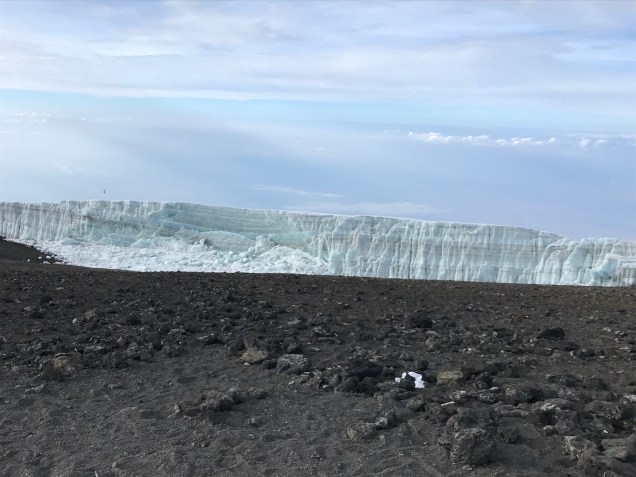
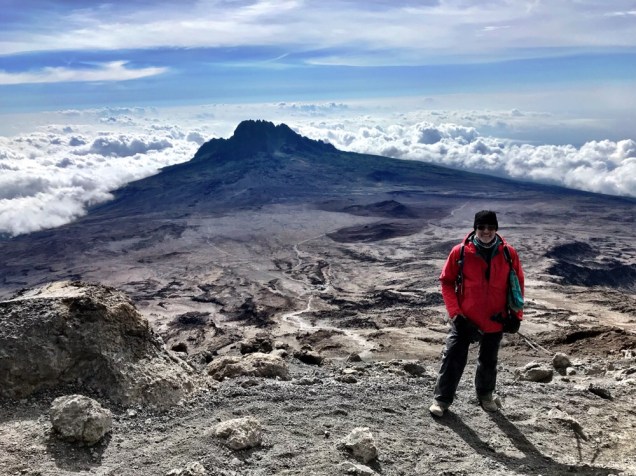
Once I reached Gilman’s Peak (the destination of many), the sun was rising, but I still had at least another hour of climbing to the true top. The trek to the top was around the cone of the volcano to the opposite side; we walked along what was often a mere three foot wide path that, with one misstep, would lead to a five-hundred foot plunge into the core or, on the other side, a thousand foot slide to the glaciers.

At this point, the lack of oxygen made me extremely fatigued. My body was in slow motion as was my brain. I was extremely thirsty and hungry. I carried a CamelBak hydration system with me and had taken precautions to prevent it from freezing…yet, the hose froze. To reduce the weight of my pack, I had given my insulated backup water bottle to the lead guide, never intending to be separated (we were separated when he took the girls ahead along with my backup water).

As I plugged along zombi-like taking chameleon steps (two steps, stop, breathe, two steps, stop, breath,….forever it seemed), I came to a point where my energy level was at a low. I had to have something to eat and drink. I stopped, took off my pack, and retrieved a ProBar. It, too, had frozen and turned to powder. I ate it anyway. With no saliva in my mouth, it stuck to my teeth, roof, and sides of my mouth. A new low was reached. Thankfully, my experience guide, Charles, took the CamelBak out of my pack, smashed it around to break up the ice, and opened the filler cap to allow me to drink. Nothing tasted better.

We continued on like that for a while, stopping, sipping, and him telling me we only had a few more minutes to go. I would stand up, shuffle forward, take in the absolutely amazing views, and tell myself, “I will make it even if it takes all day.”

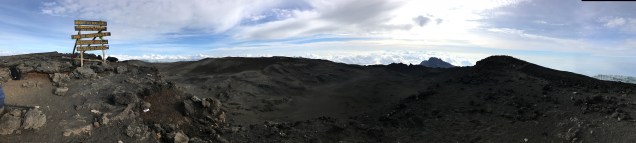
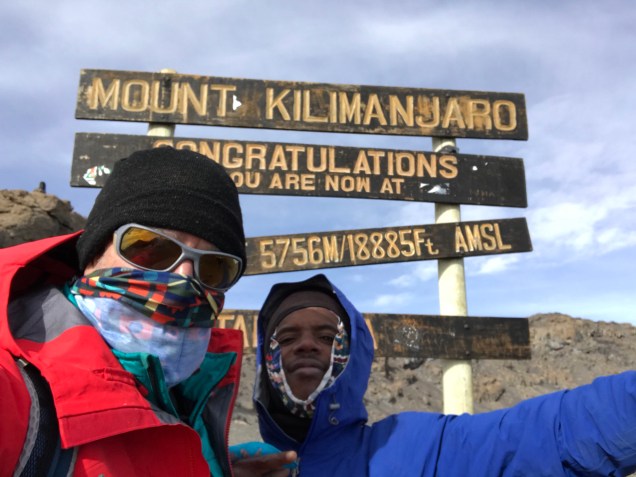
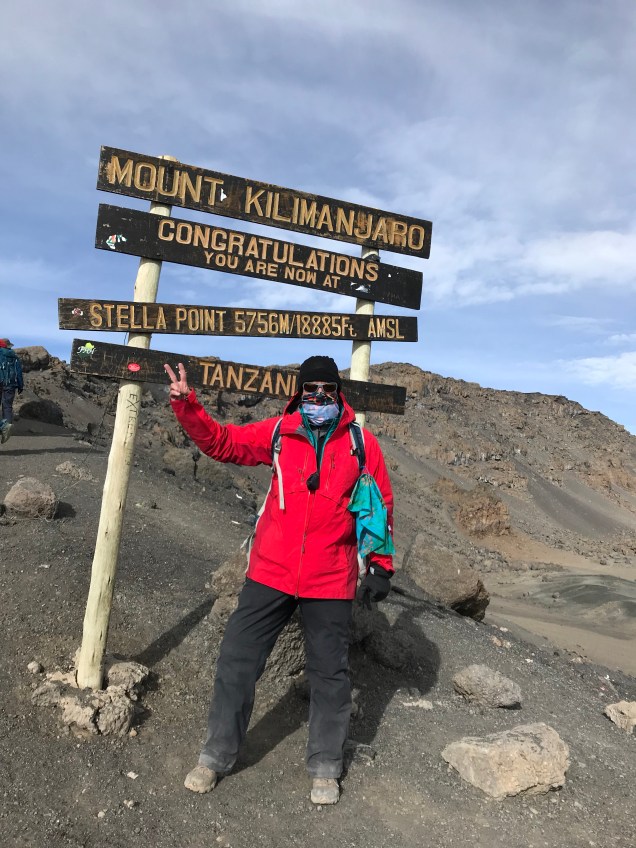
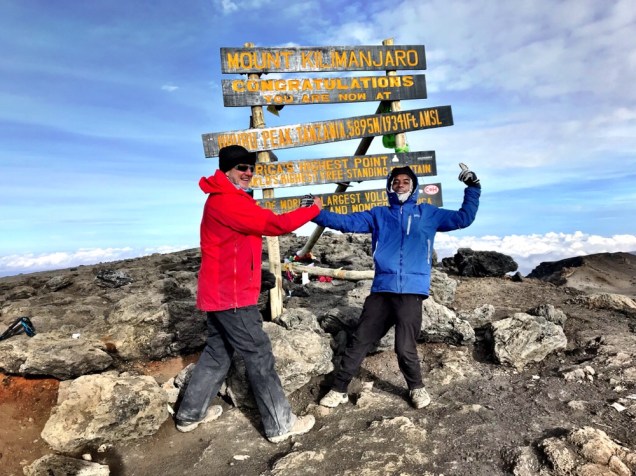
As it turned out, it didn’t take all day to reach the summit (just an hour and a half). When we got there at 0721 in the morning, a few other people were posing at the sign. They stayed long enough to take a few pictures, then headed out. I had climber 19,341 feet for this one moment. I wasn’t going to be deprived. The wind was howling, it was well below freezing (-20), and there I stood. The sense of accomplishment was great, but it was shadowed by the knowledge that I still had nine to ten hours of trekking ahead of me.

Charles and I had our picture made standing in front of the sign, then Charles made a few of me. I had taken my right glove off to use my camera. I left it off for about two minutes too long. The back of my hand become frost burned…a rookie mistake. Charles was now very cold, so we started back down the mountain toward Kibo Hut retracing our steps.

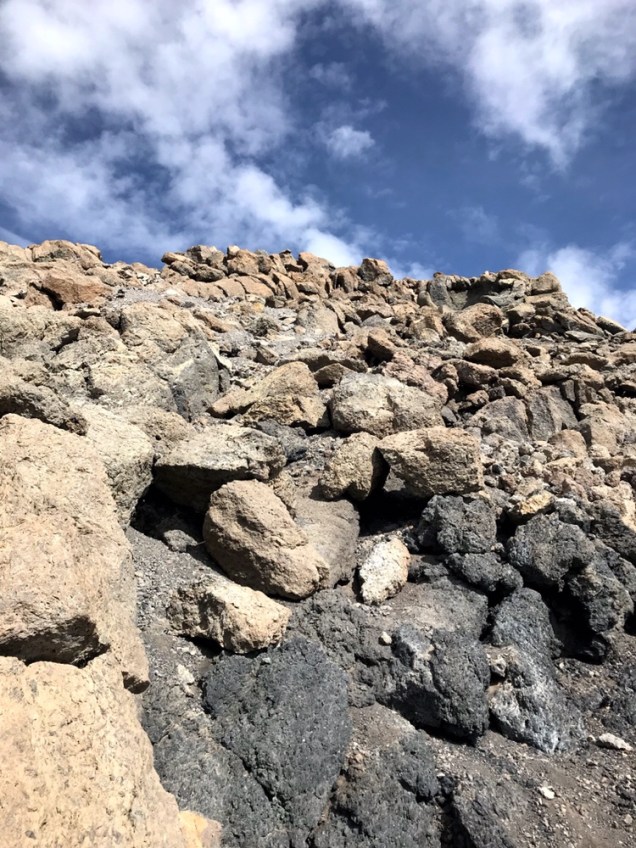
The journey back was very tough on my knees; the boulders, rocks, and scree don’t allow for steady footing. You slide down more than walk. It was probably a good thing we climbed in the dark, because the hundreds of switchbacks though the boulders would have been very intimidating had we seen them up close.

Once back at Kibo, covered from head to toe in volcanic dust, I thought about the climb. About achieving a long time dream. About overcoming physical and psychological obstacles. About the beauty of this world. About the kindness of other men. But most of all, about how fortunate I was to be there at all. I had been where only a small percentage of the human race had been. I was, and still am, a very lucky man.

Face Your Fears and Do It Anyway: Climbing Kilimanjaro.

Many of the steps we take in life are in the dark, where we are scared, where our hearts pound, and where we head toward a place we haven’t been before. But rest assured, there is always guidance and some light to lead us on our paths. We can overcome our fear and doubt, and climb to higher ground.

On the night of November 12th, I and four other fellow trekkers along with five guides, started the steep climb up Kilimanjaro at midnight. It was below freezing with 25 mph winds at the Kibo camp at an elevation of 15,500’.

It was pitch black outside. It was bone chilling cold. The air was thin and it was difficult to breathe. With only a few hours sleep, we would gather together and start our climb. The only light was from our headlamps; the rays of the headlamps cast a ghostly aura over the alpine desert landscape. We could see only ten feet in front of us.

I was warm in my multiple layers of technical clothing and confident in my abilities, but others started to shiver and openly cast doubt on their competence. I ignored the open grumblings, and relied on the instincts and knowledge of our guides to lead us up the formidable monster known as Kilimanjaro. They knew the climb was possible…they were confident and had done it many times before. I trusted them.

The climb would be a slow slog, one or two steps at a time, then take a breath. Over and over again and again. The 4,000 foot ascent from Kibo to Gillman’s Peak would take almost six hours, and then another hour-and-a-half around the volcanic cone to arrive at Uhuru, the highest point on the mountain.

The climb is perhaps one of the hardest physical undertakings I have ever done. Not because of lack of physical strength, but because of lack of oxygen. Being able to breathe is a gift we often ignore; to take a deep breath, to slow down, and be at ease is often taken for granted. Without adequate oxygen, your body does funny things. We all react differently.

From the very start of the climb that night, some were already reacting to the high altitude. A few were lethargic and slow to respond. Just ten minutes into the climb, other climbers along the way we’re turning around. Within half an hour, some were vomiting and others feeling extreme pressure in their guts. Edema also plays its game with our brains and lungs, forcing some to quit out of agony. By the time we reached the peak, at least two people had to be evacuated off the mountain by rescue teams and transported to Kenya by helicopter. The climb is far from easy.

I was lucky in that I didn’t experience any deep problems. But at the crest, I have never felt fatigue like I felt there. It not only slowed my body down, but made my normally positive mind occasionally doubt itself. I was extremely thirsty (my camelbak hose had frozen) and hungry. By this point, our team had broken up into three units. I was alone with my guide, Charles. He stayed close to me for the duration.

Without his guidance and help, I might not have made it to Uhuru. He helped me with food and water. He slowed me down by taking “chameleon steps.” But most importantly, he kept me focused with encouragement…with a positive outlook and a can do attitude. He was there for me.

It wasn’t easy or a jog up the mountain. I have done four full Ironman races and hundreds of other triathlons, swam open water courses, landed on aircraft carriers, been caught flying in hellacious thunderstorms, been through a divorce, and practiced law, but none compares to the effort it took to climb Kili. None.

But, the lesson taught that night is similar to so many other lessons I’ve learned in my life. The lesson was a reiteration of what my parents taught me over the years…if you want something badly enough, face your fears, focus, and just do it. Don’t let fear and the pronouncements of others keep you from achieving your dreams. We are all unique and can accomplish so much more than we think we can if we only take one step at a time and focus on the moment.

What are your dreams? What are you waiting for? Who is really holding you back? I think deep down you know the answer. The answer lies within yourself.

(Turn the sound up watching this video- the howling wind adds to the effect).

The ebb and flow of life.

Life is often a matter of perspective. We often make mountains out of molehills, but just as easily, we can also make molehills out of mountains.

Climbing Kilimanjaro was an affirmation of that philosophy. We can reach new heights if we take one step at a time; and those steps have to be taken slowly and methodically, and not rushed with your hair on fire. We CAN make a molehill out of a mountain.

Each day of our lives presents new opportunities to “climb mountains.” We are given new opportunities to reach higher, learn more, grow more, and be more. We must continue to adapt and evolve. Within each of us is the ability to improve ourselves and the world around us.

Mastery comes from pushing yourself beyond your comfort zone. Life is like a series of waves, highs and lows. You must push yourself to new highs, then restore yourself during the lows. It is a continuing rhythm to get better. The journey isn’t easy, but it is well worth the effort.

Climbing Kilimanjaro: Day 3

Climbing Kilimanjaro: Day 3

My first look at Kilimanjaro was during the night drive from the airport to the Halisi Resort. My driver pointed it out in the distance. There it was…huge, magnificent, bold, and stark against the lighter grey sky. It was almost scary in its size compared to the surrounding area. Its appearance made my heart pound.

The mountain not only attracted me with its size and beauty, but emotionally as well. It motivated me to seek an inner calling for a bigger ambition – to challenge myself with a world class climb. I was now in Kilimanjaro after months of waiting. It was about to begin.

I wrote about day one of the climb in an earlier post (www.LawyairOnTheRun.com). Day one took us from 6,000 feet up to 9,000 where we spent our first night. It set the pace for the adventure to come; that pace would involve resolve, digging deep, focus, and a steady, non-compromising discipline.

Day two started at 0630 with a wake up call and a hot, wet towel and a cup of coffee. The night had been spent in a Mandara Hut listening to the blue monkeys yelling at each other into the early hours. The sun was now rising as I walked to breakfast.

Breakfast consisted of lots of water, coffee, fresh fruit, porridge, sausage, eggs, and toast with honey. They did not want us to go hungry during the climb (the chef meticulously prepared the food and carried the eggs and other fragile items up the mountain himself).

After breakfast and packing up, we set out for our seven-and-a-half mile trek from 9,000 feet up to 12,200. Horombo Huts were are goal. We would be leaving behind the tropical forest for the bleaker heath and moorlands. The vegetation becomes thinner as you move up the mountain, as does animal life. As we arrived at Horombo, the only mammals seen were the many four-striped grass mice scurrying around.

The climb at this point starts getting very rocky and the pace slows down to accommodate them. At some points, the incline hits thirty to forty degrees, which plays havoc on knees. But these steep episodes are short lived and interspersed so you can get your breath back.

The weather was clear for the first four hours are so, and we had our first views of both Kibo and Mawenzi peaks. Kilimanjaro consists of three volcanoes, Kibo, Mawenzi, and Shira. Shira is the oldest of the three and stopped erupting about 500,000 years ago. Mawenzi formed from the Shira caldera and still stands today. Then, 460,000 years ago, an enormous eruption west of Mawenzi formed Kibo. Kibo is a dormant volcano and could erupt anytime (molten magma lies just 400m below the surface). Uhuru Peak is the highest part of Kibo’s crater rim and is our climbing goal. The peaks, although majestic on first sight, still seemed a long way off.

About two hours in, you leave behind the trees and start walking through heathers and tall grass. The path is enveloped by burned areas destroyed by a fire in 2008 that took much of the vegetation.

We stopped for lunch (fried chicken, cheese, cookies, and carrots) at an area with tables and a couple of “crows” that continually attempted to steal our food. During this time, the clouds rolled in, the temperature dropped dramatically, and it started to hail. Fortunately, we had finished eating and had time to dress for the change in weather. For the next hour, we climbed with the hail and cold rain. Now, the slipperiness of the wet rocks on the increasingly steep slopes made for a slow climb.

About two hours later and a now clear sky, we reached Horombo Huts and were again greeted by our porters as they broke into song; if anything in the world can pick your spirits up, it is the music from these men. I will always cherish their happiness and glee for life. They are amazing athletes and go about their difficult tasks with huge smiles on their face.

The huts are small and A-framed and have three bunks in each; other trekkers using different outfitters sleep in tents pitched around the compound. There are bathrooms for men and women with sinks, two toilets and a shower in each (the coldest water I have ever felt – I didn’t use the shower until after the summit and on the way down…it felt GREAT at that time).

As usual, we spread our sleeping bags and other equipment out and had a half our for personal time before our daily hot tea and popcorn was served. The tea was always welcome and the popcorn was a great snack that delivered the right amount of salt; that time was always fun to relax and talk about the day. About an hour after that, dinner was served in the community dinning hall. The aforementioned mice loved the fact we were there since the ran around grabbing all the food that “accidentally” dropped to the floor.

The dinning hall was busy with about 100 trekkers, some on the way up the mountain, and others on their way down. We sat next to three people from England on one side, and six Americans on the other. The British consisted of a man and his wife and her sister; the six men were a father and son and four friends- all missionaries spending time in Africa. We got to know them well during the climb and dinners. There are just some fantastic people in this world doing amazing things.

We are all capable of doing more than we think; our own minds often limit us. Life is a mind game and our fears can prevent us from accomplishing our desires and dreams. When we learn how to control our thoughts, minimize our fears, and step forward in the direction of our dreams, we start to live the way we can imagine. It is truly limitless if we only try.
Climbing Kilimanjaro: Day 1

We all climb mountains. We all navigate storms. Our life journeys are remarkably similar. But the degree to which we climb and navigate in our journeys varies greatly.

I like the big adventures; the big thrills that get my heart pumping and my mind humming. A few weeks ago, I climbed Kilimanjaro in Africa; it is one of the Seven Summits (the seven highest peaks on seven continents). It was grueling and exhausting, but, for me, an ultimate in life achievements. It was a physical, mental, and spiritual quest that filled me to the core. I loved it.

Here is a brief look into the second day of the expedition; our REI group left the Kilimanjaro Halisi Resort around 8 am and started the climb from Marangu Gate around 10.

The five of us and 22 guides and porters trekked from 6250’ up to the Mandara Huts at 8934’ in just over 5.6 miles. The somewhat smooth dirt path at the beginning soon gave way to ever-increasing in steepness rock. The path is through tropical forest with occasional blue monkeys and the vivid red Impatiens Kilimanjari, a small flower that resembles the profile of an elephant when turned sideways, that kept us somewhat distracted.

In my group was Rob, and American Airlines A-320 Captain, and his son, Morgan. They are from Knoxville TN, and like me, are doing their first high-altitude summit. Ursula is a 70 year old mountaineer from Phoenix AZ who has climbed Mount Everest and is working on completing the seven summits. Oh, she also has two complete knee replacements. And Patty, 58, is from Columbus Missouri, and she is also an accomplished mountain climber with extensive experience including the heights of those peaks in Nepal and others around the world.

Once we arrived at the Mandara Huts, we had some time to settle in before we sauntered up to the parasitic volcanic cone known as Maundi Crater. From atop the crater we could see east into Kenya and north-west toward Mawenzi. We were surrounded by both blue and colobus monkeys yelling out to each other as we entered their territory. The reason for the trek up to Maundi is to “climb high, and sleep low” to get our bodies acclimated to high altitude.

I hope you enjoy my insights and can be inspired by them to climb a little higher in your own adventures and life.

Kilimanjaro: Mountain of Greatness

Kilimanjaro! The word is poetic. Majestic even. It has been rolling around in my mind for a long, long time. A lone mountain in Tanzania Africa that has enticed and beckoned me to come have a look and give it a crack; it is an imposing geographical oddity that has called me to test my inner being and physical stamina.

Standing just shy of twenty-thousand feet in elevation, it is one of the world’s highest peaks. Some thirty-thousand trekkers attempt to climb it each year; it is accessible, but also deadly. Only three quarters of those that start the climb reach the summit, and ten die on its slopes each year. Altitude sickness is the main culprit brought about by climbing too fast and not allowing the body to acclimate to the rarified air. It is but no means a walk in the park.

The Masai call the mountain the “House of God.” It is a big, beautiful mountain that was formed by the twin forces of fire and ice. It is three volcanoes, with the dormant peaks of Kibo and Mawenzi forming the summits of two of them. Uhuru Peak is the highest peak of Kibo and the goal of my climb. Although dormant, hot, molten magma lies only 400 meters below the surface, and scientist say an eruption can happen any day.

I leave for this journey on Thursday, October 5th, my Mother’s birthday. It is fitting to depart on that day, since she is largely responsible for my adventurous streak. She thought there was nothing I could not accomplish in life. She inspired, prodded, and cajoled me into trying bigger, scarier, and more demanding tasks. She imprinted in my mind the fact that I could face my fears and just do it. She loved life, travel, people, and adventure. She would not only approve of this quest, but she would have been my biggest cheerleader. Although she is no longer here to do that, she is very much alive in my soul and spirit. It is with that spirit that I will always seek bigger and better things.

I fly from Atlanta Thursday night and arrive in Amsterdam Friday morning. I plan on staying the day to acclimate to the time change, and then catch a KLM flight to Kilimanjaro Saturday morning. The flight arrives at 1950, where I expect to be greeted by an REI representative to usher me through customs and then on to Moshi. Moshi sits in the midst of coffee farms started by Catholic missionaries in 1898. After a night’s rest and breakfast, a trekking orientation will be followed by a coffee plantation tour and a warm up nature walk.

On Monday, we will start by hiring porters, signing in, and beginning the climb. The trek begins at the park gate at the 6,000 foot level and hikes 6 miles up to Mandara hut through the bamboo rainforest (home of blue monkeys and the vivid Impatiens Kilimanjari). The Mandara huts are named after the fearsome chief of the Moshi, a warrior whose skill and bravery on the battlefield was matched only by his avarice off of it.

Day four (Tuesday, 10th), involves an eight hour, strenuous trek to the 12,340 level. It is at this level the first glimpse of the Kibo summit is available. The hike passes from rainforest into high moorland and beneath the rocky southern face of Mawenzi, one of the three volcanic peaks that make up Kilimanjaro.

Day five is an acclimatization day as we hike high and camp low. A climb up to Zebra Rocks will allow for a view across The Saddle and exercise to help cope with the thinning air. After the hike, its back to camp for dinner and a little time to read and reflect (I am bringing Marcus Aurelius’ Meditations with me to read and contemplate upon).

Day six we cross The Saddle in about seven hours and reach the 15,520’ level. The steepness of this leg of the climb, along with the altitude, slows people down. The Saddle is a wide flat plateau at the base of Kibo. The views are said to be fantastic. After a light dinner, it’s rack time. But not for long. The guides will wake us before midnight for day seven and the summit attempt. By Gillman’s Point (18,640’), the temperature will be below freezing. The hike at this point is extremely steep and on a scree slope; it will be one step at a time taking time to focus on breathing and ignoring head and other body aches.

If all goes well, the sun will rise by this time and the plains of Africa will be visible all around. But we will not stop here. With another 2 to 3 hours of trekking, the true summit, Uhuru, lies ahead. At 19,340’, the top is the goal. With the very thin air, not much time is spent here before the descent is started. From the peak down to Horombo Huts is 9.5 miles, making it about fifteen hours of hiking for the day.

The final day (Saturday the 14th) is a five hour descent from Horombo to the park gates for a celebration dinner. After dinner, its back to Moshi and the first shower and cold drink in a week. On Sunday the 15th, I catch a flight back to Amsterdam and then connect to Atlanta and home on Monday around 1500.

I invite you to follow my progress as I post on FaceBook and other media sources. I hope that you will be inspired by what I am doing, not just for the physical aspects, but the mental as well. Life is an adventure and is truly beautiful. We all have it in us, we just need to dig deep and bring it forth. Find what inspires you, and do it. Don’t sit on the sidelines, but tally forth and participate.

Until my next post, twendai (Swahili for, let’s go)!